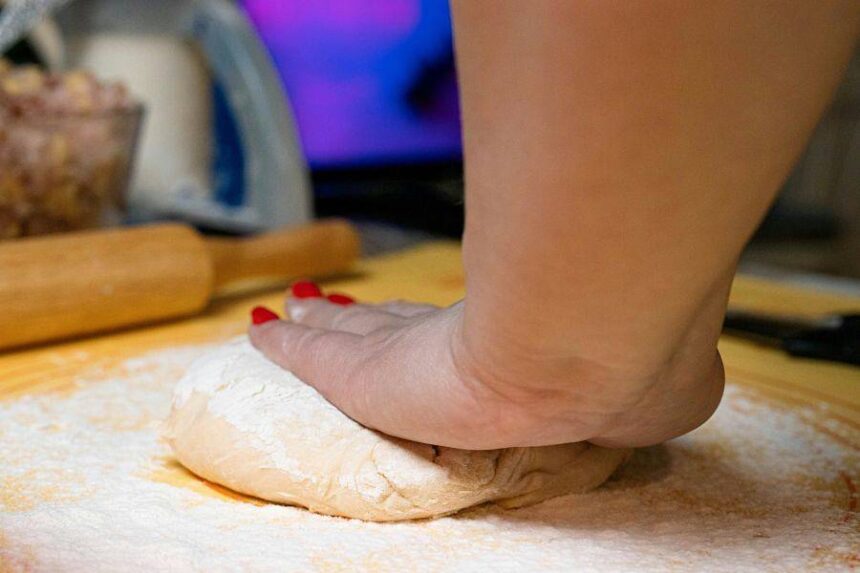

There comes a moment when a gastronomic innovation stops being a novelty and becomes part of the established restaurant landscape. For the pinsa recipe, that moment has arrived. Born in 2001 from Corrado Di Marco’s intuition, pinsa has moved through the curiosity phase, overcome initial skepticism, and earned a stable place on menus in restaurants, pizzerias, and specialized venues throughout Europe. No longer an exotic alternative to pizza, but a complementary proposition that meets specific needs of the contemporary market.
The added value that convinces restaurateurs and consumers
Observe the menu of any establishment that has introduced pinsa: you’ll notice it doesn’t replace pizza but stands alongside it, creating a diversified offering that attracts new customer segments. The dough’s lightness, with its characteristic open crumb structure, wins over those seeking a less heavy gastronomic experience. The high digestibility, resulting from 72 hours of leavening, responds to the needs of an increasingly health-conscious public concerned with post-meal comfort.
From an entrepreneurial perspective, pinsa offers attractive margins without requiring prohibitive investments. While special flours cost slightly more than traditional ones, the perception as a premium product allows for higher price positioning. A balance that many restaurateurs have learned to appreciate, especially in a market where differentiation is increasingly crucial for standing out.
The success story repeats across different contexts: from specialized pinserias that have made it their core business, to restaurants proposing it as a gourmet alternative, to bars using it to refresh their lunch offerings. Each format finds its optimal expression, demonstrating the product’s commercial versatility.
The operational simplicity hidden behind apparent complexity
When a restaurateur first examines the pinsa recipe, two elements stand out: the 80% hydration and the 72-hour leavening time. Numbers that might intimidate, but which in practice translate into concrete operational advantages. The dough, prepared with 720 grams of Di Marco flour, 500 grams of water, and a few other essential ingredients, follows a standardized protocol that eliminates most variables.
The long leavening, far from being an obstacle, becomes a planning tool: the dough is prepared during quiet moments and slowly matures, ready for intense service periods. The manual “pinching” technique, which replaces the rolling pin, is quickly learned and doesn’t require years of experience like traditional Neapolitan pizza stretching.
Those wishing to fully master the technique will find in Di Marco’s modern pinsa recipe a detailed guide that accompanies them step by step through preparation. For those preferring to optimize timing, pre-baked bases exist that maintain organoleptic characteristics while reducing service to five minutes in the oven.
A range of possibilities: from classic recipes to creative innovation
The pinsa’s irregular surface, with its characteristic indentations, becomes a canvas for infinite interpretations. The six canonical recipes trace a path of increasing complexity that each restaurateur can follow according to their ambitions. It starts with the Margherita, a tribute to tradition that gains new lightness on pinsa. It moves through Prosciutto and Mushrooms, an evergreen that never disappoints, and Four Cheeses, where balancing intense flavors becomes art.
The bolder proposals open unexplored territories. Ham and Pears plays on sweet-savory contrast with unexpected elegance. Mediterranean with olives and sun-dried tomatoes brings southern sunshine to every bite. The combination of Mango and Prosciutto di Parma challenges purists but wins over curious palates, becoming a signature dish at venues that have made innovation their banner.
This versatility translates into concrete opportunities: pinsa works as refined finger food for aperitifs, a substantial yet light single dish for lunch, a gourmet proposal for dinner. Each format finds its audience, each recipe its ideal consumption moment.
A calibrated investment for sustainable returns
Introducing pinsa to an existing menu doesn’t require structural revolutions. A mixer, already present in most establishments, is sufficient to begin. Staff training, while important, doesn’t require extensive time: in a few days, the basic skills for producing consistently quality pinsas are acquired.
The real investment is cultural: understanding that pinsa doesn’t compete with pizza but occupies its own space in the gastronomic landscape. Establishments that have embraced this philosophy report growing satisfaction from both customers and economics. You don’t need impressive numbers to understand that a product attracting new customers, increasing average tickets, and differentiating the offering represents an interesting opportunity.
The market confirms this intuition: online searches for pinsa recipes grow steadily, training courses register as sold out, new pinserias regularly open in cities large and small. It’s no longer about following a trend but about responding to established demand.
Pinsa has completed its transformation from gastronomic curiosity to contemporary classic. For restaurateurs, it represents a low-risk, high-potential diversification opportunity. For consumers, an alternative that combines Italian tradition with modern innovation. In this balance between past and future, between simplicity and complexity, pinsa has found its winning formula. A formula that, twenty-three years after its creation, continues to conquer palates and balance sheets with the same effectiveness as day one.